 Studies
Told it’s anxiety? What a new autoimmune study found
6,607 people. 43% of the women were told it was in their heads first. Here’s the study, what it can’t prove, and what to say next time.

You described your symptoms and the doctor asked if you’ve been under a lot of stress lately.
Before a single test.
If that’s you, a 2026 study of 6,607 people with autoimmune disease says you’re in a very big, very tired club.
Here’s what it found, what it can’t prove, and how to ask for a physical cause to be ruled out first.
What the study found
Researchers at the University of Cambridge and the University of East Anglia surveyed 6,607 people who have an autoimmune disease.
That’s the kind where your immune system goes after your own body, like lupus, rheumatoid arthritis or multiple sclerosis.
They asked what people were told before they got the right diagnosis.
- 43% of women and 33% of men said their symptoms were first blamed on mental health.
- 34% of women and 22% of men were told it was psychosomatic, which is doctor for “it’s coming from your head.”
- Women were almost 50% more likely to report a psychiatric misdiagnosis.
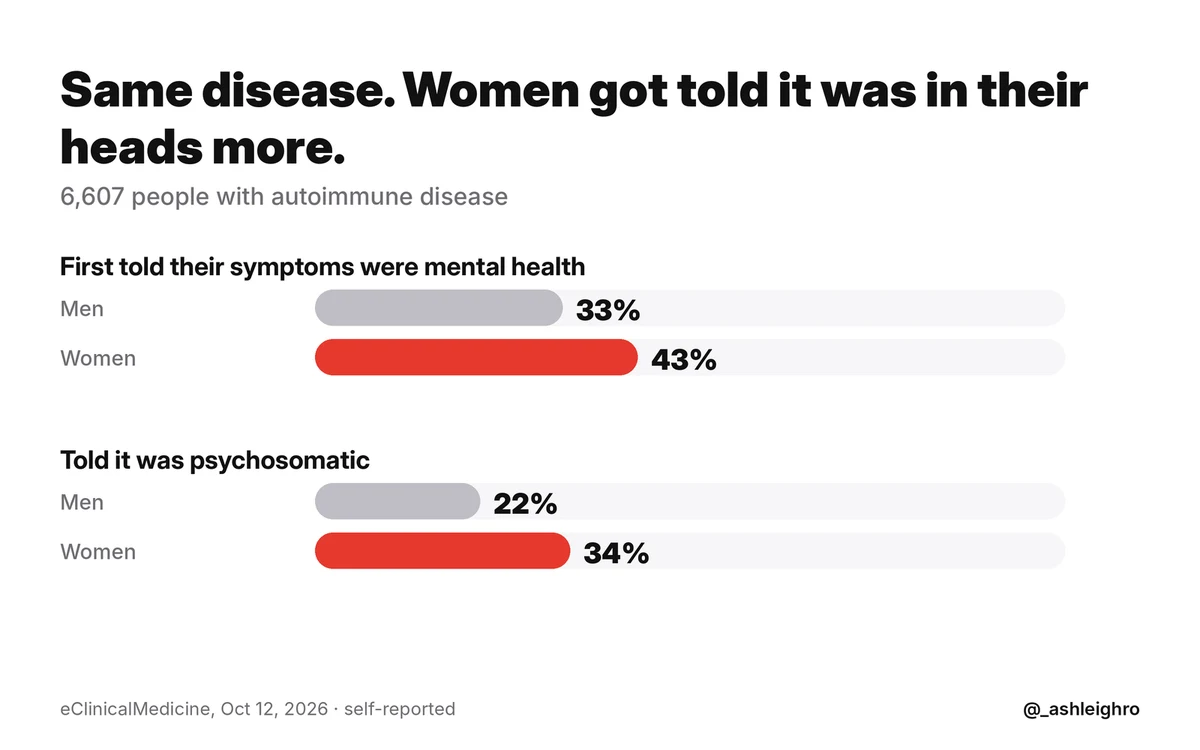
Same diseases.
10 more women out of every 100 got sent home with a stress talk first.
It came out in eClinicalMedicine on October 12, 2026, and my medical AI specialists pulled it for me the same week.
What it can’t prove
It’s self-reported.
People told researchers what they were told, and nobody checked it against medical records.
So it shows the pattern people lived, not why it happened.
And anxiety and autoimmune disease can both be real at the same time.
Being stressed doesn’t mean you’re not also sick.
Being sick is stressful.
Wild.
What that label costs
A 2025 Cambridge survey of more than 3,000 patients found more than 80% said a psychosomatic or mental health misdiagnosis hurt their self-worth.
72% said it still upset them, often decades later.
They were also more likely to stop trusting doctors and avoid care.
So the cost of “it’s just stress” isn’t one bad appointment.
It’s every appointment you skip after it.
Who gets dismissed the most
It’s not random.
- Women. In more than 21,000 ER records from the US and Israel, women were less likely to get pain medicine at every pain score. In an experiment, nurses rated the exact same pain as less intense when the patient was a woman (PNAS, 2024).
- Black patients. Across 14 studies, Black patients had about 40% lower odds of getting pain medicine in the ER than white patients (American Journal of Emergency Medicine, 2019).
If you’re both, you already knew that.
Now you have the citations.
What to do when you’re told it’s anxiety, in 4 steps
- Bring a rough timeline of your symptoms, even with guessed dates.
- List every test you’ve had, and the ones you haven’t.
- Ask, word for word. “Can we rule out a physical cause first?”
- If the answer is no, ask them to note in your chart that you asked for testing and why it wasn’t done.
You’re not being difficult.
You’re being specific.
A second opinion is not you being difficult
In 286 patients referred to Mayo Clinic for a second opinion, 21% got a completely new diagnosis and 66% got a refined one.
Only 12% walked out with the same diagnosis they came in with.
Asking for another set of eyes is normal.
It’s also how a lot of people finally get the right answer.
Do this today
Write down every time a symptom got called stress or anxiety.
Rough date, who said it.
Receipts.
How I know
I have a positive ANA at 1:80, and it’s still an open question.
Nobody has told me what it means for me yet.
I’m not a doctor.
Medicine isn’t my field, so I built my medical AI specialists, over 30 AI agents, one for every department you could get a medical degree in.
They search new peer-reviewed research for me every day and found this study for me this week.
They don’t diagnose.
They help you walk in with the right questions, and the receipts.
This isn't medical advice. Anxiety is real too, and getting care for it never means a physical cause shouldn't be checked.
Sources
- Women with autoimmune diseases more likely to receive psychiatric misdiagnoses, News-Medical on eClinicalMedicine, Oct 12, 2026
- Chronic diseases misdiagnosed as psychosomatic can lead to long-term damage, University of Cambridge, 2025
- Women and ER pain treatment, PNAS, 2024 (EurekAlert)
- Racial disparities in ER pain treatment, American Journal of Emergency Medicine, 2019
- Second opinions at Mayo Clinic, 2017