 Studies
What you need to know about hemorrhagic ovarian cysts
Your discharge papers said “follow up with gynecology” and nothing else. Here’s the rest. The recheck, the red flags and the questions.

You spent hours in the ER and left with a printout, a “follow up with gynecology” and thoughts and prayers.
Then nobody booked anything.
A hemorrhagic ovarian cyst is a cyst that bled inside.
There’s a part your papers probably didn’t spell out.
When it needs another look, when you go back, and what to ask so you’re not starting from zero next time.
What a hemorrhagic ovarian cyst is
Most people with regular periods form a small cyst on an ovary most months.
It’s part of ovulating.
Many never notice, and most go away on their own.
Follicle cysts usually fade in 1 to 3 months, and corpus luteum cysts in a few weeks.
A hemorrhagic cyst is one of those that bled inside.
That bleeding is what can make it hurt like hell, and what sends a lot of people to the ER.
About 8% of premenopausal women get large cysts that need treatment.
So common doesn’t always mean nothing.
Do you need a follow-up ultrasound?
This is the part that gets skipped.
Radiologists have guidance on it, and it mostly comes down to size.
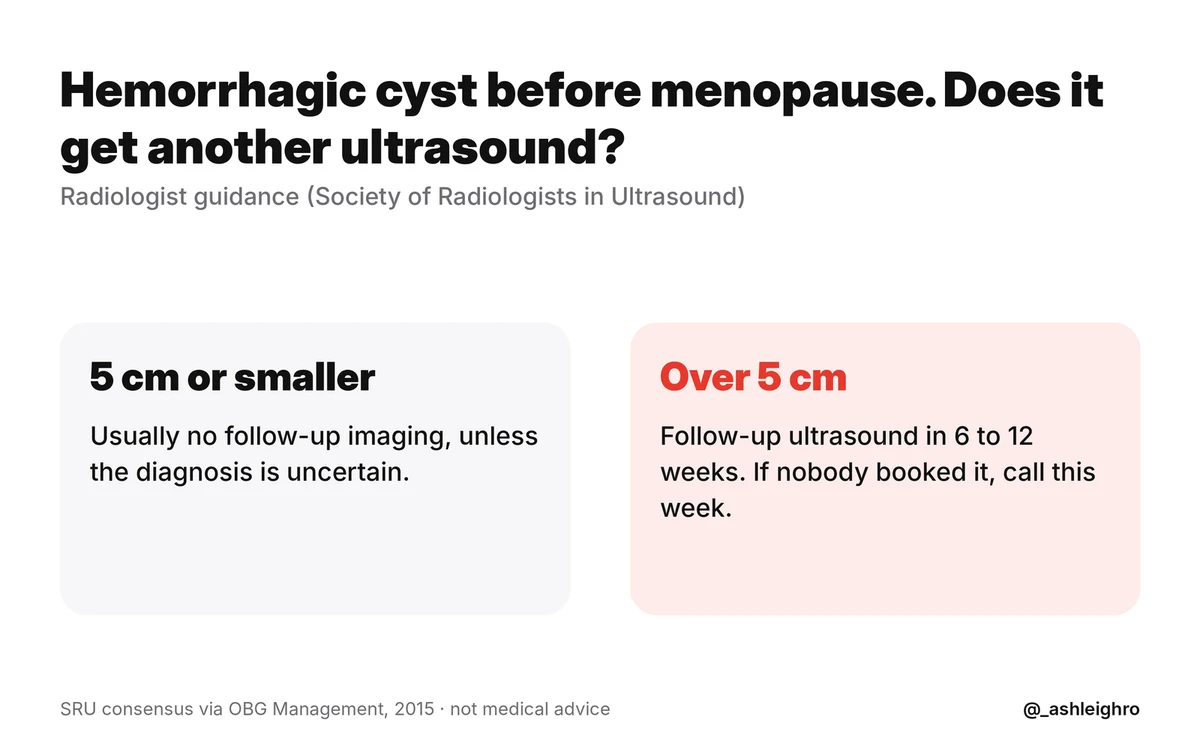
- If you haven’t gone through menopause and the cyst is 5 cm or smaller, radiologists usually recommend no follow-up imaging, unless the diagnosis is uncertain.
- If you haven’t gone through menopause and it’s over 5 cm, they recommend a follow-up ultrasound in 6 to 12 weeks.
- If you’ve recently gone through menopause, any size gets a follow-up ultrasound in 6 to 12 weeks to make sure it went away.
Find the size on your papers.
It’s usually in centimeters, like “5.1 cm.”
If it’s over 5 and nobody booked a recheck, that’s your call to make this week.
When to go back to the ER (don’t wait these out)
If you know you have a cyst, these are the signs health sources list for getting help right away.
- Sudden, severe belly or pelvic pain.
- Pain with fever and vomiting.
- Feeling faint, dizzy or weak.
- Breathing fast.
- New pain when you already know you have a cyst.
One reason these matter is ovarian torsion, which is when the ovary twists.
It’s an emergency, and the risk goes up with a cyst 5 cm or bigger.
Torsion rarely fixes itself.
If any of those are happening, stop reading and go.
Call 911 if you can’t get there safely.
What happens if one ruptures
A ruptured cyst sounds terrifying.
In one hospital’s study of 78 women who came to the ER with a ruptured cyst and internal bleeding, 80.8% were treated without surgery.
That’s one hospital, so it’s a picture, not a promise.
If it keeps happening (hi, me too)
You’ve done the teas.
The diet.
The gym.
Still in the ER.
Here’s what the sources actually say.
- You can’t prevent these cysts while you’re ovulating.
- Hormonal birth control can lower the chance of new ones, because it stops ovulation.
- Birth control doesn’t shrink a cyst you already have.
- Doctors may talk about surgery if a cyst doesn’t go away after a few cycles, keeps growing, looks unusual on ultrasound or keeps causing pain.
None of that is a decision you make alone.
It’s a conversation, and you should walk into it with questions.
5 questions to ask your gynecologist
- How big is it, and what type is it?
- Do I need a follow-up ultrasound, and when? Who’s booking it?
- Could it be an endometrioma, the kind of cyst endometriosis causes?
- Has PMOS, the new name for PCOS, been checked?
- What should send me back to the ER?
What to bring so you don’t start from zero again
- Your discharge papers.
- Your last ultrasound report, the full one.
- A rough list of every ER visit for this, with the size each time if you have it.
- Your 5 questions.
Do this today
Find your discharge papers.
Yes, the ones in the car.
Look for the cyst size and the words “follow up.”
How I know
October 14, 2026, I was in the ER with a 5.1 cm hemorrhagic cyst on my right ovary.
My papers said “also seen on prior exam.”
I end up in the ER for this at least once a year.
I’m not a doctor.
Medicine isn’t my field, so I built my medical AI specialists, over 30 AI agents, one for every department you could get a medical degree in.
They search new peer-reviewed research for me every day.
They don’t diagnose.
They make sure I walk in with the right questions, and the list above came out of it.
This isn't medical advice. If you have sudden, severe pain, call 911 or go to the nearest ER.
Sources
- Ovarian cysts, US Office on Women’s Health
- Ovarian cysts, MedlinePlus
- Follow-up guidance for hemorrhagic cysts, Society of Radiologists in Ultrasound via OBG Management, 2015
- Simple adnexal cysts update, Radiology, 2019
- Ovarian torsion, Healthdirect
- Ovarian torsion, Cleveland Clinic
- Ruptured cysts with internal bleeding, PLoS One, 2014