 Studies
Your report says “within normal limits.” Here’s why that can be bullshit.
Normal is the summary. The numbers are underneath. Here’s how to read the part nobody read to you.

Your MRI, your bloodwork or your ultrasound came back “within normal limits” and you still feel like shit.
Your portal notification said “no action needed.”
Your body said otherwise.
Both can be true.
The top line is one person’s summary of a lot of numbers, and nobody reads you the numbers in a 15 minute visit.
So we’re doing it here.
1 in 5 people who read their notes found a mistake
Researchers asked 22,889 patients to read their own visit notes.
21% found a mistake.
42% of the people who found one called it serious.
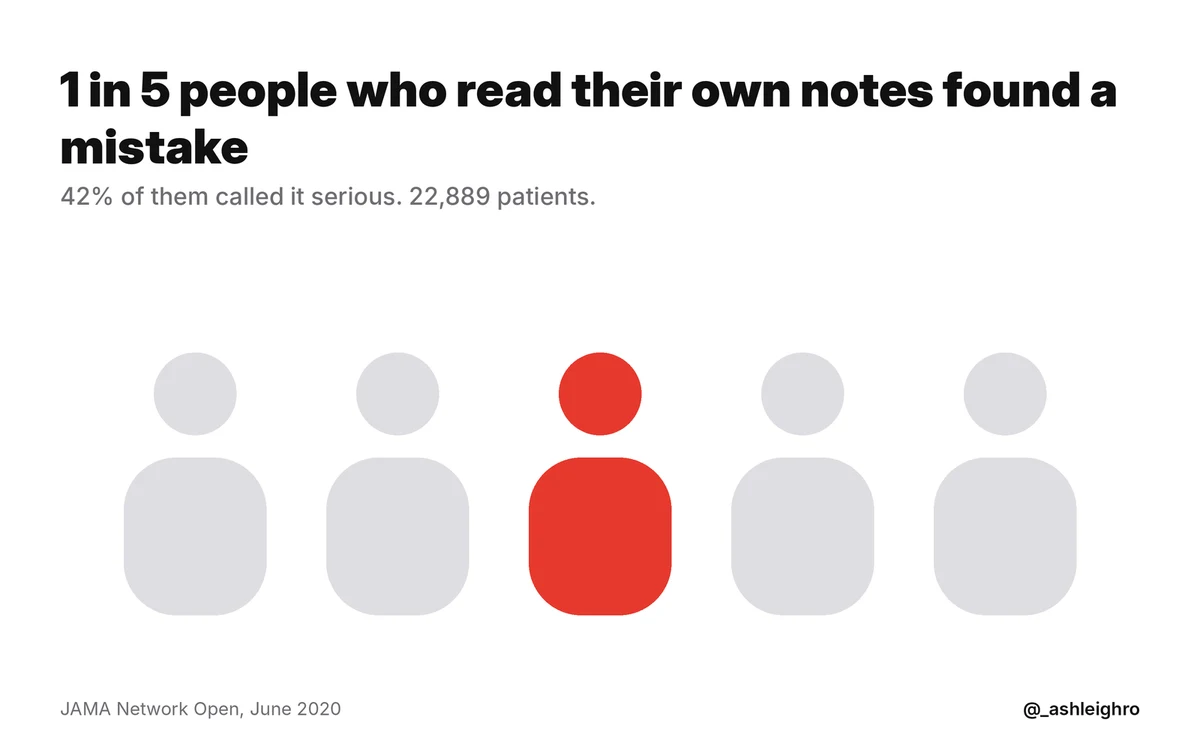
The serious ones were mostly in the diagnosis (28%), the medical history (24%) and the medications or allergies (14%).
It was published in JAMA Network Open in June 2020.
Nobody’s saying your doctor is lying.
They’re saying read it yourself.
How a report is built
Most imaging reports have the same parts.
- Findings. What the radiologist saw, piece by piece, often with measurements.
- Impression. The 1 or 2 line summary, usually at the bottom. This is the only part most people read, and the part your portal shows you first.
Bloodwork is similar.
There’s your number, the lab’s normal range next to it, and maybe a flag if you’re outside it.
The impression is where “within normal limits” lives.
The findings and the numbers are where your questions live.
Normal for who?
A lab’s normal range is usually built from a group of healthy people, and it covers most of them, not all of them.
That means 2 things.
- You can be inside the range and still be a change for you. If your number was in the middle last year and it’s at the edge now, that’s worth a question.
- “Normal” on the summary line doesn’t mean every number under it was boring.
Ask how today’s number compares to your own last one, not only to the range.
Your records don’t follow you around
In 2023, only 43% of US hospitals could routinely send, receive, find and use records from outside their own system.
That’s from the federal health IT office.
So the specialist reading your scan might be reading half your story.
Bring the other half.
4 questions to ask about any report
- What does this number mean for someone my age?
- Why didn’t it make the summary?
- How does it compare to my last one?
- Can I get the full report and the images?
How to get your full report and images
- Check your patient portal first. Look for “full report,” not just “results.”
- If it’s not there, ask the office or the imaging center for a copy. Under HIPAA, you have a right to a copy of your own records.
- Ask for the images too. They’re usually given as a download link or a disc.
- If you find a mistake, ask how to request a correction to your record.
Do this today
Open your last report.
Read past the first line.
Circle every number you don’t understand and bring them.
How I know
My brain MRI from March 2026 says “within normal limits.”
The numbers on the same scan put my white matter in the 2nd percentile for a woman my age.
I’m not saying my radiologist is wrong.
I want that gap explained, and I would never have seen it if I’d stopped at the first line.
I’m not a doctor.
Medicine isn’t my field, so I built my medical AI specialists, over 30 AI agents, one for every department you could get a medical degree in.
They read the whole report, not just the first line, and search new peer-reviewed research for me every day.
They don’t diagnose.
They tell me which numbers to ask about.
This isn't medical advice. Talk to your doctor about any result before you change anything.